Here at Beer Kit Brewer we have exactly one obsession: coaxing a genuinely good beer out of a humble kit can. So when our handbook lands that sets out to do the very same thing — turn a nervous first batch into a beer you actually want to share — it earns a spot on the bench. How to Home Brew Beers: The Complete Kit Brewer’s Handbook by J.J. Ryan is that book, and it is the most useful thing we’ve put next to the fermenter in a long while.
It is drawn from the deep archive at How to Home Brew Beers, then expanded and re-sequenced into one continuous, start-to-finish guide and put through a full technical review. That last part matters. Instead of a stack of separate articles answering one question at a time, you get the whole process laid out in the order you actually brew in — 17 chapters and 9 appendices, from opening the kit to pouring the first proper pint.
The Complete Kit Brewer’s Handbook — available on Kindle and free on Kindle Unlimited.
What you’re actually getting
Kit brewing is easy to start and surprisingly easy to get wrong. The gear is cheap, the instructions look simple, and yet a first batch can still come out flat, cloudy, or faintly off — almost always because of a handful of small things nobody spelled out. This book is built to close those gaps for two kinds of brewer at once.
For the first-timer opening their first kit
Sanitation, demystified. The single biggest cause of ruined beer, explained until it stops being a mystery.
Temperature control on a budget. How to hit the right fermentation range without buying a chamber.
Knowing when it’s done. Reading your hydrometer and your fermenter instead of guessing.
Bottling and carbonation without the mess. The priming and conditioning steps that turn flat beer into a proper pint.
For the brewer with a few batches behind them
Upgrading a kit without overcomplicating it. Simple additions that lift flavour and body.
Diagnosing off-flavours. A clear route from “something tastes wrong” to the cause and the cure.
Yeast, done properly. Pitching, healthy fermentation, and repeatable results batch after batch.
Consistency, on purpose. How to record what you did so you can brew that good batch a second time.
The brewing problems it actually fixes
If you’ve ever tipped a batch down the drain and not known why, this is the book that saves the next one. It skips the jargon and walks through the exact moments that make or break a brew — sanitation, temperature, gravity, carbonation — in plain language, in the order you meet them. No flicking back and forth wondering what comes next.
If our own Beginner’s Guide to Brewing Beer from a Kit got you through your first can, think of this handbook as that same journey with every gap filled in and every step in sequence — the version you keep open on the bench from the first pour of hot water to the last capped bottle
Should you grab it?
Short version: yes. On Kindle the whole book lives on your phone, which is exactly where you want it — searchable, one tap away, right next to the fermenter while you’re mid-brew and second-guessing a reading. You have two easy ways in: buy your copy outright and keep it on the shelf for good, or read it free through Kindle Unlimited and start tonight. Either way, your next batch can be the one you’re proud to hand around.
Buy it outright, or read the whole thing free on Kindle Unlimited.
Beer Kit Brewer takes commission from the Amazon Affiliate Program. As an Amazon Associate we earn from qualifying purchases — at no extra cost to you.
It is a mineral deposit, mostly calcium oxalate, often bound together with protein, hop resin, yeast residue, and other brewing soils.
That is what makes beerstone so irritating. You can scrub it. You can rinse it. You can hit it with sanitizer. It may still sit there, rough and chalky, giving microbes a place to hide and giving your next batch a problem before fermentation has even started.
The fix is not brute force. The fix is understanding what beerstone is, how it forms, and which cleaning chemistry actually removes it.
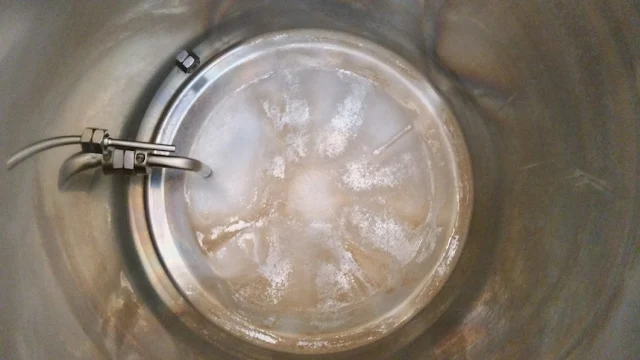
Beerstone can begin as a dull haze before building into a rough mineral scale that normal rinsing will not remove.
What Beerstone Looks Like
Beerstone usually appears as a white, grey, yellow, tan, or brownish film. In early stages it may look like a cloudy patch on stainless steel. In worse cases it becomes rough, crusty, and firmly attached to the surface.
The easiest clue is resistance. Yeast residue, sugar film, and most hop grime usually soften after a proper hot alkaline clean with a brewery cleaner such as PBW. Beerstone tends to remain because the mineral portion is not mainly organic soil. It is a low-solubility mineral deposit.
It can form in obvious places, such as kettles and fermenters, but the hidden areas are often more dangerous. Keg posts, poppets, beer taps, racking arms, dip tubes, ball valves, bottle fillers, transfer lines, and plate chillers can hold beerstone long after the visible tank wall looks clean.
Quick Test
If the residue feels greasy, sticky, or soft after soaking, it is probably organic brewing soil. If it feels chalky, rough, or mineral-like and survives a normal alkaline clean, beerstone or hard water scale is more likely.
What Beerstone Actually Is
Beerstone is mainly calcium oxalate. In simple terms, calcium from brewing water and malt reacts with oxalate from malt. When those ions meet under the right brewing conditions, they form calcium oxalate, a mineral salt with very low solubility in water.
The simplified reaction looks like this:
Ca2+ + C2O42- → CaC2O4
The calcium ion, Ca2+, comes from brewing water, malt, and brewing salts. The oxalate ion, C2O42-, comes largely from malted grain. Once calcium oxalate forms, it can fall out of solution and attach to brewing surfaces.
In real brewing equipment, beerstone is rarely pure calcium oxalate. It usually forms as a mixed deposit. Protein, hop resin, yeast residue, polyphenols, trub, and other organic material can help bind the mineral crystals to stainless steel, plastic, rubber, and beer-line surfaces.
This is why beerstone removal usually needs two kinds of cleaning. Alkaline cleaners help remove organic soil. Acid cleaners help dissolve mineral scale. Sanitizer comes after cleaning. It does not replace cleaning.
The Conditions That Cause Beerstone
Beerstone is not random. It forms when the chemistry, temperature, and surface conditions are right. Some brewers see it rarely. Others fight it constantly because their water, process, or cleaning routine encourages scale formation.
Hard Water
Hard water contains higher levels of calcium and magnesium. Calcium is useful in brewing. It helps with mash enzyme performance, yeast flocculation, hot break formation, and beer clarity. Too much unmanaged hardness, however, can increase mineral deposits in vessels, kegs, taps, and lines.
If beerstone keeps returning, do not simply increase cleaner strength and hope for the best. Look at your water profile. If your water is very hard, consider diluting with reverse osmosis water and rebuilding your brewing salts more deliberately.
Malt-Derived Oxalate
Malted barley naturally contributes oxalate. That does not make malt a problem. It simply means every batch gives beerstone the raw material it needs. High-grain bills, repeated brewing, and poor cleaning after wort contact can gradually build deposits, especially where liquid dries onto the surface.
Heat and Evaporation
Hot surfaces encourage deposits because water evaporates and dissolved material becomes more concentrated. Kettles, heating elements, heat exchangers, and hot-side fittings are common beerstone zones. A plate chiller can be especially awkward because the narrow internal passages are difficult to inspect and easy to neglect.
Wet and Dry Cycles
Repeated wetting and drying makes mineral deposits harder. A small haze left after one batch becomes a tougher layer after the next. This is one reason delayed cleaning causes trouble. Letting wort, beer, or yeast residue dry inside equipment gives the mineral and organic layers more time to cling.
Scratched or Rough Surfaces
Beerstone attaches more easily to rough surfaces. Scratches in stainless steel, damaged plastic, worn beer line, old rubber parts, and valve threads all create grip points for mineral deposits and microbes.
Beerstone Compared with Other Brewing Deposits
Not every white or brown mark is beerstone. Before choosing a cleaner, it helps to know what you are dealing with.
Deposit
What it looks like
Main cause
Best cleaning approach
Beerstone
White, grey, tan, yellow, or brown mineral film. Often rough or chalky.
Calcium oxalate bonded with brewing residues.
Alkaline clean, rinse, then acid beerstone remover.
Sticky, greasy, brown, greenish, or resinous residue.
Wort protein, hop oils, trub, yeast, and dried krausen.
Hot alkaline cleaner such as PBW.
Biofilm
Often invisible, sometimes slippery or dull.
Microbial growth on poorly cleaned surfaces.
Proper cleaning first, then sanitizing.
The Risk to Beer Quality
Beerstone is not only cosmetic. It creates rough, protected surfaces where spoilage organisms can survive. A clean-looking fermenter or keg may still have tiny mineral pockets that protect bacteria and wild yeast from normal sanitation.
This is one of the reasons a brewer can sanitize carefully and still get recurring infection problems. Sanitizer works best on already-clean surfaces. If microorganisms are hiding under mineral scale, sanitizer may not reach them properly.
Beerstone can also contribute to off-flavors and inconsistency. Deposits in beer lines, taps, and kegs may hold old beer residues. That can create stale, sour, buttery, phenolic, or generally muddy flavors depending on what organisms or residues are present.
There is also a physical effect. Rough mineral patches can act as nucleation sites for carbon dioxide. In kegs and bottles, that can encourage foaming, gushing, and inconsistent pours. If the beer tastes fine but pours like a disaster, dirty lines, scale, and rough hardware should be part of the investigation.
For more on spotting infection problems, see this guide to how to tell if your beer is infected. For chemical treatment in brewing and wine contexts, this article on Campden tablets is also useful background, although Campden tablets are not a beerstone remover.
The Correct Cleaning Logic
The best way to think about beerstone removal is simple: clean first, descale second, sanitize last.
Alkaline cleaners remove organic brewing soil. That means yeast, protein, hop resin, trub, fatty residues, and biofilm. Acid cleaners remove inorganic mineral scale. That includes beerstone and hard water deposits. Sanitizers reduce microbial load on clean surfaces before use.
Those jobs should not be blurred together. Sanitizer does not clean. Acid does not replace a full organic clean. Alkaline cleaner does not always remove mineral scale. Each product has a job.
Cleaning Order Matters
For most homebrewers, the safest routine is alkaline clean, rinse, acid clean, rinse, then sanitize before the next use. This removes organic soil first, then gives the acid cleaner direct access to the mineral layer.
Some commercial beerstone removers use a different sequence, including acid followed by a non-caustic alkaline cleaner. Follow the product label. Do not mix acid and caustic products. Do not invent your own chemical sequence.
A Practical Beerstone Removal Method for Homebrewers
This process suits fermenters, kettles, kegs, taps, stainless parts, and most brewery-safe hardware. Always check cleaner labels for concentration, contact time, temperature range, and material compatibility.
1. Rinse loose soil immediately
As soon as the beer, wort, or yeast is drained, rinse the vessel with warm water. Do not let krausen, trub, or sticky wort dry onto the surface. Fresh soil is easy to remove. Dried soil becomes a bonding layer for mineral deposits.
2. Run a hot alkaline clean
Use PBW or another brewery-safe alkaline cleaner at the recommended rate. Warm to hot water improves cleaning power, but do not exceed the product’s instructions. Soak, recirculate, or scrub gently with a non-abrasive cloth or pad.
3. Rinse thoroughly
Rinse until the surface no longer feels slippery and the rinse water runs clean. This step matters because leftover alkaline cleaner can interfere with acid cleaning and can create unsafe reactions if incompatible chemicals meet.
4. Use an acid cleaner for the mineral layer
Apply a brewery acid cleaner or dedicated beerstone remover. Products based on phosphoric acid, nitric acid, or blended brewery acids are commonly used for mineral deposits. Dedicated beerstone removers may also include surfactants and chelating agents that help lift calcium-based scale.
5. Give the cleaner enough contact time
Do not splash acid cleaner around for thirty seconds and expect miracles. Beerstone removal takes contact time. Follow the label. Keep the surface wet for the full recommended period. For kegs and lines, circulation is often better than a static soak.
6. Disassemble hidden parts
Take apart keg posts, poppets, taps, bottling wands, dip tubes, racking gear, and ball valves. Beerstone often survives in threads, seals, and internal passages. A shiny fermenter wall means little if the valve is still carrying old mineral scale.
7. Rinse, dry, and inspect
After the acid step, rinse according to the product label. Let stainless steel dry fully before storage. Inspect under good light. A clean surface should look even and feel smooth, not chalky, gritty, or cloudy.
8. Sanitize only before brewing or packaging
Sanitize before the next use. Do not treat sanitizer as a storage solution or a cleaning shortcut. Sanitizer is the final step after proper cleaning, not the thing that saves a dirty surface.
Beerstone removal is safer and more effective when you use the right chemistry instead of aggressive scrubbing.
Cleaning Kettles, Fermenters, Kegs, and Beer Lines
Kettles
Kettles collect hot-side deposits because wort is heated, concentrated, boiled, and splashed against metal surfaces. Beerstone can form around heating elements, welds, pickup tubes, sight glasses, and areas where wort dries after the boil.
Rinse the kettle soon after use. Run a hot alkaline clean to remove protein and hop residue. If a dull mineral film remains, use an acid cleaner. Avoid abrasive pads that scratch stainless steel, because scratches make the next deposit easier to anchor.
Fermenters
Fermenters collect krausen rings, yeast film, dry hop residue, and beerstone. The krausen ring is mostly organic soil, so alkaline cleaning is the first move. Any chalky haze that survives may need an acid step.
Pay close attention to taps, racking arms, thermowells, sample valves, lids, seals, and threaded fittings. These small parts are often more contamination-prone than the main vessel wall.
Kegs
Kegs are major beerstone traps because beer sits in them for weeks or months. The inside walls may look clean, while dip tubes, posts, poppets, and liquid disconnects hold scale and old beer residue.
Break kegs down regularly. Clean with an alkaline cleaner, rinse, then use an acid cycle when mineral deposits are suspected or as part of scheduled maintenance. Replace worn O-rings and damaged seals. Old rubber can hold flavor and contamination even after cleaning.
Beer Lines and Taps
Beer lines are easy to neglect because you cannot see inside them. That is exactly the problem. Beerstone, yeast residue, hop compounds, and biofilm can form inside lines and taps, giving every pour a stale or sour edge.
Use beer line cleaner as directed. Periodically use an acid line cleaner where suitable. Pull taps apart for manual cleaning. If lines are old, stained, stiff, or carrying flavor, replacing them is often cheaper and smarter than trying to rescue them forever.
Best Prevention Methods
Clean before deposits dry
The best beerstone removal method is preventing the first layer from setting. Rinse equipment while residues are still soft. Do not leave a fermenter with a dried krausen ring for days. Do not leave kegs sitting with dregs and foam inside them. Do not let wort dry inside the kettle overnight unless you enjoy punishment.
Use both alkaline and acid cleaning
A brewer who only uses alkaline cleaner may remove organic grime while leaving mineral scale behind. A brewer who only uses acid may attack minerals while leaving organic soil in place. The better routine uses both, at sensible intervals.
For normal homebrewing, every batch does not always need a heavy acid clean. But if you brew often, use hard water, keg regularly, or see recurring haze and rough patches, scheduled acid cleaning is worth adding to the routine.
Manage water hardness
If beerstone is a constant issue, check your water profile. Hard water brings more calcium and magnesium into the system. Calcium still has brewing value, so the goal is not automatically zero calcium. The goal is control.
Reverse osmosis water gives you a cleaner starting point. From there, you can build the profile with measured additions of calcium chloride, calcium sulfate, magnesium sulfate, or other brewing salts depending on the style. Guesswork is where problems begin.
Keep stainless steel smooth
Do not use steel wool inside brewing vessels. Do not attack stainless steel with harsh abrasives. Do not use rough pads unless they are rated for brewery stainless. Scratched stainless gives beerstone and microbes more surface area to grip.
If you need mechanical help, use soak time first, then a soft cloth or brewery-safe cleaning pad. Let chemistry do the hard work.
Disassemble equipment on a schedule
Valves, taps, keg posts, disconnects, and transfer hardware should not be treated as permanently clean because liquid passed through them. Flow is not cleaning. A line or valve can carry beer while still holding mineral scale and old residue in hidden corners.
Dry equipment before storage
Standing moisture helps deposits and corrosion. After cleaning and rinsing, drain equipment properly and allow it to dry. Store kegs, fermenters, and fittings so they do not trap puddles.
Common Beerstone Mistakes
Relying on sanitizer to fix dirty equipment. Sanitizer is not a cleaner and will not dissolve beerstone.
Using only alkaline cleaner forever and wondering why a white mineral haze remains.
Using only acid cleaner without first removing yeast, protein, hop resin, and dried krausen.
Mixing acid and caustic products. Rinse between incompatible cleaners unless a manufacturer gives a specific controlled process.
Scrubbing stainless steel with steel wool or harsh abrasives.
Use a brewery-safe acid cleaner or dedicated beerstone remover for mineral scale.
Follow dilution, temperature, and contact time instructions.
Disassemble valves, taps, keg posts, poppets, and dip tubes.
Inspect surfaces under good light.
Dry equipment before storage.
Sanitize only before the next use.
Review your water hardness if beerstone keeps coming back.
The Clean Surface Is the Goal
Beerstone is a chemistry problem, not a character test. If it keeps coming back, the answer is not harder scrubbing. It is better process.
Use alkaline cleaners for organic soil. Use acid cleaners for mineral scale. Rinse between incompatible products. Keep equipment smooth, dry, and disassembled often enough that hidden deposits do not become permanent residents.
Once that routine is in place, beerstone stops being a mysterious white crust at the bottom of the brewing nightmare. It becomes just another maintenance problem with a clear cause, a clear removal method, and a clear prevention plan.
Always follow the safety directions and material compatibility advice printed on any brewing cleaner, sanitizer, acid wash, caustic wash, or beer line cleaner you use.
Introduction to pH in Cider Brewing: The Chemistry of the Apple
When we pour a glass of cider, we are experiencing the delicate, molecular balance of sugar, tannin, and acidity. At the very center of this structural trinity is pH level, a measure of how acidic or basic a solution is. In the art of cider brewing, pH is not merely a number on a digital screen. It is the invisible architecture of your brew.
Chemically defined as $pH = -\log[H^+]$ (the negative logarithm of the hydrogen ion concentration), this metric dictates everything from yeast kinetic energy and aromatic ester production to the sheer survivability of your cider in the bottle. For serious cidermakers, manipulating and understanding this acidic backbone is the difference between a flat, lifeless beverage and a vibrant, professional-tier craft.
Why pH Matters in Cider: The Four Pillars of Fermentation
To master cidermaking, we must first abandon the idea that fermentation is a passive process. It is a biological battlefield, and pH is the terrain. The acidity of your apple must dictates the behavioral patterns of the yeast you pitch. Saccharomyces cerevisiae, the workhorse of fermentation, thrives in a mildly acidic environment (ideally between 3.2 and 3.8 pH).
If your starting juice drops too low, plunging below 3.0, the elevated hydrogen ions create a toxic, stressful environment for the yeast cell walls. This stress response often results in sluggish, stalling fermentations, or worse, the secretion of foul-smelling sulfur compounds (hydrogen sulfide) that can ruin an entire batch. Conversely, a pH that is too high leaves the yeast vulnerable to competition from wild, rogue microbes.
Beyond yeast kinetics, the sensory layer of your cider, the very flavor profile that hits the palate, is entirely dependent on this acidic structure. In the cidermaking world, acidity provides the "spine" of the drink. Malic acid, the dominant acid in apples, delivers that sharp, green-apple bite. A perfectly balanced pH interacts with the fruit's natural tannins to create a mouthfeel that is crisp and refreshing.
If the pH creeps too high (above 3.9), the cider will taste "flabby," syrupy, and structurally dull, even if it has fermented completely dry. On the other hand, if it dips too low, the result is a harsh, astringent beverage that strips the enamel from your teeth.
Then, there is the critical issue of microbial stability. A low-pH environment is one of nature's greatest defense mechanisms. Spoilage organisms, including devastating bacteria like Acetobacter (which turns cider into vinegar) and film yeasts, struggle to reproduce in highly acidic conditions.
By maintaining a pH below 3.8, you are actively erecting a chemical fortress around your hard work. This ensures that only your chosen, cultivated yeast strains consume the sugars.
Finally, we must discuss sulfite effectiveness. This is perhaps the most misunderstood concept in homebrewing. When you add a Campden tablet (Potassium Metabisulfite) to your cider, it doesn't just broadly sanitize the liquid. It dissociates into different forms of sulfur dioxide ($SO_2$), but only the molecular form of $SO_2$ actually protects the cider.
The amount of molecular $SO_2$ available is directly tied to the pH of the liquid. At a highly acidic pH of 3.0, a tiny dose of sulfites yields a massive amount of protection. At a higher pH of 3.9, you would need to dump hazardous amounts of sulfites into the cider to achieve the same protective effect. Therefore, blindly dosing Campden without knowing your pH is essentially flying blind.
Testing pH: Elevating Your Cellar Practices
To truly control your final product, guessing is no longer an option. You must implement rigorous lab practices. Historically, brewers relied on pH Strips (or litmus paper). While these are inexpensive and require zero calibration, they operate on a colorimetric system.
When dealing with cider, especially ciders rich in anthocyanins (red-fleshed apples) or dark tannins, the color of the liquid inherently stains the paper, muddying the results. While a pH strip might tell you if your cider is generally acidic or basic, it cannot provide the granular data (like the difference between 3.4 and 3.6 pH) required to calculate precise sulfite additions. They are best reserved for educational purposes or an absolute emergency backup.
For the serious artisan, the non-negotiable standard is the Digital pH Meter. These devices use potentiometric glass electrodes to measure the electrical potential difference in the liquid, offering stunning precision. While they represent a larger upfront investment and demand regular care, the return on investment is the elimination of guesswork.
You will know exactly where your fermentation stands. When choosing a tool, opt for meters that offer automatic temperature compensation (ATC) and multi-point calibration. It is a tool for those who prioritize exact science over rough estimation.
Optimizing pH Testing: The Masterclass Methods
Having the right equipment is only half the battle. Knowing how and when to deploy it separates the amateurs from the masters. The frequency of your testing dictates your level of control. We recommend a strict three-phase testing protocol. Test immediately after pressing the juice, midway through active fermentation, and just prior to packaging.
This allows you to track the acidic arc of the cider and catch potential issues, like an unexpected malolactic fermentation (which raises pH), before the cider is sealed in glass.
A crucial pro-tip involves temperature management. The pH of a liquid is not static. It fluctuates directly with temperature due to the changing kinetic energy of the molecules. Always ensure your cider sample is at room temperature (around 68°F/20°C) before dropping the probe in.
If you are cold-crashing your cider near freezing, a reading taken immediately will be fundamentally inaccurate compared to its cellar temperature.
Furthermore, your digital instruments are only as reliable as their last calibration. Using a digital pH meter requires respect for the electrode. You should be calibrating your unit with precise 4.01 and 7.01 buffer solutions before every single brewing session.
Keep meticulous cellar notes. By keeping detailed records of starting, mid, and final pH levels alongside your tasting notes, you build a historical database. This is how you transition from making "lucky" good batches to consistently engineering award-winning cider year after year.
Interpreting and Manipulating pH Results
Once you have an accurate reading, the real artistry begins with intervention. If your raw apple juice presents a pH that is too high (above 3.8), you are in the danger zone for spoilage and a flabby flavor profile. In this scenario, we perform an acid addition.
Using a calculated blend of malic acid (to mimic the apple's natural profile) or an acid blend, you can actively drive the pH down into a safe, crisp range. Conversely, if you are working with incredibly sharp heirloom apples and the pH sits at an enamel-stripping 2.9, you must buffer the acid.
This can be achieved chemically by carefully dosing food-grade calcium carbonate (chalk) or potassium bicarbonate. It can also be done biologically by encouraging a Malolactic Fermentation (MLF), where bacteria convert sharp malic acid into softer lactic acid, naturally raising the pH.
Ultimately, this data dictates your chemical preservation strategy. As previously discussed, a lower pH exponentially increases the efficacy of your sulfites. If your cider rests at an ideal 3.4 pH, a standard dose of Campden will provide perfect microbial stability.
But if your cider sits at 3.8, you will need to significantly increase your sulfite dosage to achieve the required parts-per-million (PPM) of free molecular $SO_2$. This interconnected dance between acidity and sulfites is the secret to aging cider beautifully without it oxidizing into cardboard-flavored vinegar.
Conclusion
Testing and managing the pH level of your cider is far more than a routine chore. It is the fundamental practice that governs the entire lifespan of your brew. It informs the structural integrity of the flavor, guarantees the safety of the fermentation, and dictates the precise chemical interventions required to bring your vision to life.
By moving away from guesswork and adopting the precise testing methods and chemical understanding of a master cider maker, you transform raw fruit into an exceptional, repeatable craft.
Once your cider has completely fermented and your acidic structure is locked in, the real magic of maturation begins. It's time to refine those flavors and bottle condition your masterpiece for the perfect, effervescent pour.
For brewers of every stripe, from the weekend hobbyist in the garage to the seasoned professional in the commercial cellar, the quest for the perfect pint is a constant, relentless pursuit. While intense hop aroma and deep malt flavor often take center stage in recipe design, the absolute secret to a truly unforgettable beer often lies hidden in its physical texture.
A velvety, rich, and creamy mouthfeel can elevate a simple, good beer to a truly great one, transforming each sip into a luxurious, satisfying experience. It is the difference between drinking flavored water and enjoying a crafted culinary beverage.
Before we dive into the specific biochemical and mechanical techniques required to achieve this, let us establish our benchmark. If you have ever enjoyed the beautiful, cascading pour of a fresh Kilkenny or a proper Guinness Draught, you inherently know the absolute gold standard of creamy. A massive, defining reason for their signature texture is the innovative blend of carbon dioxide and nitrogen used for carbonation, a complex topic we will explore later.
Master Your Grains for a Fuller, More Viscous Body
The fundamental foundation of your beer's physical body is the malt bill. Beyond simply dictating the final color and the base flavor profile, malts are your primary, raw material tool for building viscosity and textural richness.
By carefully selecting your specific grains and actively adjusting your mashing process, you can chemically engineer a beer with a substantial, silky texture that coats the palate.
1. Strategically Boost Your Grain Bill and Specialty Malts
The most direct, brute-force path to a fuller body is simply increasing the overall grain bill. This deliberately raises the original gravity of the wort, leaving behind a much higher concentration of unfermentable sugars and heavy proteins.
Incorporate base malts known specifically for adding body and malt sweetness, such as Munich or Vienna Malt, rather than standard 2-Row or Pilsner. For a pronounced, targeted effect, Caramel/Crystal Malts (e.g., Carapils, Caramel 60L) are excellent, highly effective choices. During their unique malting process, the starches inside these grains are converted to complex dextrins that standard yeast cannot process. These dextrins survive fermentation entirely, contributing directly to an enhanced mouthfeel and brilliant head retention.
2. Harness the Specific Power of Flaked Grains
For a truly silky, velvety texture that mimics a milkshake, look no further than raw, flaked grains. Flaked Oats are a professional brewer's absolute favorite for their incredibly high concentration of beta-glucans. Beta-glucans are gummy, water-soluble fibers that add massive viscosity to the liquid without adding fermentable sugar.
They are the signature, defining ingredient in rich Oatmeal Stouts and a mandatory cornerstone of hazy, thick New England IPAs. Similarly, Flaked Wheat and Flaked Barley contribute a high volume of raw proteins that result in a fuller, rounder mouthfeel and drastically improved head stability.
Brewer's Warning: Managing the Mash
When utilizing flaked grains, aim for 5% to 20% of your total grist. Add them directly to the mash alongside your base malts.
However, be extremely mindful that higher percentages of these gummy grains will create a very sticky mash bed, frequently leading to a disastrous "stuck mash."
Always incorporate a generous handful of rice hulls into the grain bed.
3. Actively Control Your Enzymatic Mash Temperature
Your mash temperature is the most powerful thermodynamic lever for controlling the final fermentability of your wort. Mashing at a higher temperature, typically locked between 69°C and 70°C (156°F to 158°F), heavily favors the specific enzyme alpha-amylase.
Alpha-amylase randomly chops starch into longer-chain, highly complex sugars (dextrins) that standard ale yeast cannot ferment. These complex sugars remain in the final beer, contributing directly to a fuller, sweeter, and significantly more viscous body.
Conversely, mashing at a lower temperature (around 65°C / 149°F) favors the enzyme beta-amylase, which specifically creates simple, highly fermentable maltose, resulting in a drier, thinner, and more alcoholic beer.
4. Do Not Forget Water Chemistry: The Crucial Chloride Ratio
The invisible mineral profile of your brewing water has a subtle but profoundly significant impact on texture. To chemically accentuate a soft, full mouthfeel, you must actively aim for a higher chloride-to-sulfate ratio in your brewing water.
Achieving a ratio of 2:1 (for example, building your water profile to 100 ppm Chloride against only 50 ppm Sulfate) will beautifully enhance the human perception of maltiness, sweetness, and physical fullness. This makes it the ideal chemical foundation for styles like sweet stouts and hazy IPAs. Conversely, a higher sulfate content actively accentuates sharp hop bitterness and creates a highly crisp, dry finish.
The Sweet Secret: Brewing with Unfermentable Lactose
Lactose, commonly known as milk sugar, is a highly unique and specific tool in the advanced brewer's arsenal. Unlike maltose derived from grain, standard Saccharomyces cerevisiae brewing yeast completely lacks the specific enzyme (lactase) required to ferment it.
This biological inability means the lactose remains entirely intact in the finished beer. It imparts a highly distinct, smooth sweetness and provides a massive, undeniable boost to the physical body and creamy texture. It is the defining, required ingredient in traditional styles like Milk Stouts and is the modern driving force behind heavily fruit-forward Milkshake IPAs and Pastry Sours.
To properly use lactose, you must add the powder directly to the boiling kettle during the last 10 to 15 minutes of the boil. This ensures the sugar is completely dissolved into the hot liquid and fully sanitized before entering the fermenter. A typical, safe starting dosage is 120 to 240 grams per standard 19-liter (5-gallon) batch.
However, be judicious with your measurements. The intense sweetness of lactose can very easily overpower a beer's delicate flavor profile if severely overused. It is best suited exclusively to dark, highly roasted robust styles or intentionally sweet, dessert-like IPAs where its heavy character can truly shine.
Important Allergen Note
Always remember that lactose is a direct dairy derivative. If you are brewing for a commercial taproom, for friends, or sharing your beer at a homebrew club, it is your ethical responsibility to clearly and prominently label the beer as containing lactose to protect those with dairy allergies or severe lactose intolerance.
Leverage Alpha Acids for Lasting Head Retention
While we primarily, and correctly, associate hops with sharp bitterness and floral aroma, they also play a critically important structural role in foam stability. The specific alpha acids contained within the hops undergo a chemical transformation into isohumulones during the intense heat of the boil.
These newly formed isohumulone compounds actively interact with the heavy proteins present in the beer derived from the malt. They cross-link together, creating a strong, physically rigid network that forms highly stable, long-lasting bubbles. A thick, persistent head of foam contributes significantly to the sensory perception of a creamy mouthfeel as it coats the lips before the liquid even hits the palate.
Specific hops with a naturally higher alpha-acid content, such as Chinook, Columbus, or Simcoe, are particularly effective at driving this protein reaction. While a strong bittering addition at the start of the boil is key, late-boil or hot whirlpool hop additions also contribute massive amounts of foam-positive compounds without adding excessive, palate-wrecking bitterness. For delicate styles where you desperately want a creamy head without overwhelming hop bitterness, consider using hops high in alpha acids in very small, carefully calculated late additions.
The Ultimate Creaminess: Engineering the Nitro Pour
To truly, authentically replicate the iconic, cascading creaminess of a commercial Irish Stout, you must venture away from standard carbonation and into the advanced world of nitrogenation.
Serving finished beer on a specific nitrogen and CO2 gas blend (typically formulated at 70% nitrogen and 30% CO2, commonly known as "beer gas") creates incredibly small, highly stable micro-bubbles. Because nitrogen gas is largely insoluble in liquid compared to CO2, it refuses to stay dissolved in the beer.
When poured, it violently rushes out of the liquid, producing a thick, aggressively creamy, and remarkably stable head that looks like whipped cream. This cascading effect leads directly to that signature, velvety mouthfeel that defines the style.
This advanced serving technique requires highly specialized draft equipment. You must invest in a dedicated nitrogen gas tank, a specific high-pressure nitrogen regulator, and most importantly, a specialized stout faucet.
This faucet contains a tiny restrictor plate inside the nozzle designed to force the pressurized beer through microscopic holes, violently knocking the nitrogen completely out of solution. While it represents a significant financial investment for a home taproom, the resulting pour is a truly professional and unparalleled creamy texture that is physically impossible to achieve with standard CO2 alone.
A Final Word of Caution: Avoid the Dairy Aisle
While aggressively chasing the perfect creamy texture, it is absolutely vital to stick strictly to proven, safe brewing ingredients. A very common, highly dangerous question from beginners is whether adding actual dairy cream or milk directly to the fermenter or keg is a viable shortcut to a creamy beer.
The answer from any professional brewer is a resounding, definitive no.
The heavy lipids and fats present in real dairy cream will instantly and completely destroy your beer's head retention, collapsing any foam immediately. Worse, raw dairy will quickly turn rancid in a low-alcohol environment, introducing a massive, dangerous risk of severe bacterial contamination and foodborne illness.
Achieving that dreamy, creamy mouthfeel is well within your grasp using science, not shortcuts. By thoughtfully and mathematically building your grain bill, mastering the thermodynamics of your mash, and perhaps experimenting with safe adjuncts like lactose powders or even investing in a dedicated nitrogen draft setup, you can successfully craft a beer that feels just as incredible as it tastes.
Why accuracy matters: Alcohol calculation relies on the difference between your starting sugar density (OG) and your finishing density (FG). This tool helps you accurately determine your beer's strength, attenuation, and provides advanced corrections for temperature and refractometer use.
Alcohol By Volume Calculator
Enter your Original Gravity (OG) and Final Gravity (FG). Use Advanced if readings were taken warm or with a refractometer.
Input your OG (Brew Day) and FG (Bottling Day).
Select your units (SG is standard).
Check the Results panel for ABV and Attenuation.
0.0% ABV
Attenuation: 0%ABW: 0.0%Mode: Quick
Tip: ABV is an estimate. For best accuracy, ensure your hydrometer is calibrated.
OG used-
FG used-
EquationStandard
Notes-
Advanced Configuration
If temps are left blank, the calculator assumes readings are already corrected to calibration temperature.
Refractometers read incorrectly once alcohol is present. This mode uses the Sean Terrill equation to correct for alcohol presence.
How can I increase the alcohol content of my beer?
"Adding sugar is easy. Adding sugar correctly is science."
Did you ever see the movie Men in Black? It featured the wonderful actor Vincent D'Onofrio as an angry alien that loved sugar. And lots of it. That is basically the simple answer to how to increase the alcohol content of your beer: You add sugar.
But you must do it with science. Adding sucrose (table sugar) or dextrose is easy, but the reality of fermentation science is nuanced. Simply dumping sugar into a fermenter changes the osmotic pressure on your yeast and alters the flavor profile. Like baking a cake, straying from the recipe can produce "hot" fusel alcohols (which give bad hangovers) or a thin, watery mouthfeel.
The Science of ABV: The Formula
Alcohol By Volume (ABV) represents the percentage of volume of alcohol per volume of beer. The standard formula for homebrewers to calculate the percentage of alcohol is:
ABV = (Original Gravity - Final Gravity) × 131.25
You need to increase the Original Gravity (OG)—the amount of dissolved sugars before fermentation—while ensuring your yeast is healthy enough to bring the Final Gravity (FG) down.
What can I add to my beer kit?
To increase the OG, you need fermentables. Here is a basic ingredient list with their approximate gravity contributions:
Dry Malt Extract (DME): Adds ~44 gravity points per pound. Adds body and alcohol. Preferred for quality.
Liquid Malt Extract (LME): Adds ~36 gravity points per pound. Adds body and alcohol.
Honey: Adds ~35-42 gravity points per pound. Highly fermentable, adds distinct aromatics. See our guide on using honey in beer brewing.
Brown Sugar: Adds ~46 gravity points. Adds slight molasses notes.
Using extra DME or LME (The Malt Approach)
Some brewers use extra dry malt extract as their sugar source. This is generally the preferred method for maintaining a high-quality beer. Unlike simple sugars, malt extract adds unfermentable dextrins, ensuring the beer retains a full body and "malty" mouthfeel to balance the alcohol.
The Math: In a 5-gallon batch, adding 1 lb (0.45kg) of DME adds approximately 0.009 to your specific gravity, translating to roughly 1% ABV increase.
Adding simple sugars (The Dextrose Method)
Using corn sugar or table sugar boosts ABV rapidly. However, yeast consumes simple sugars much easier than maltose. If you add too much, the yeast may become "lazy" and fail to consume the complex malt sugars, leaving you with a stalled fermentation. Furthermore, simple sugars ferment out completely, which can thin out the body. In high quantities, this leads to a "cidery" off-flavor.
The Golden Rule: Don't exceed 30% Adjuncts
It's widely recommended that no more than 1/3 (approx 30%) of your beer's total fermentables should come from non-malt adjuncts (sugar, honey, corn). If you exceed this, the beer will lack the proteins needed for head retention (foam) and may taste solvent-like.
Yeast Management: Osmotic Pressure
A big caution is that the more sugar you put in, the more pressure you place on the yeast. Osmotic Shock occurs when you pitch yeast into very sugary wort, drawing water out of the cells and stressing them.
To combat this, use Yeast Nutrients (like DAP or Fermaid K) to provide the Free Amino Nitrogen (FAN) that sugar lacks. For very high alcohol beers, consider Step Feeding: dissolving sugar in boiling water and adding it on Day 3 or 4 of fermentation, rather than all at once.
Summary Checklist:
Add extra DME for a balanced boost or Dextrose for a drier boost.
Add Honey/Syrups 2-3 days into fermentation to preserve aromatics.
Make a Yeast Starter to increase cell count.
Use Yeast Nutrient to prevent stress.
Keep temperature controlled to avoid "hot" fusel alcohol flavors.